 The two events focused on civil society organizations’ action against global plastic pollution, and emphasized the importance of local actions with global impact, featuring in-depth discussions, experience sharing, and innovative practice exchanges between representatives from Chinese industries, academia, and social organizations with their international counterparts. Key speakers included:  Xuefeng Wen (Deputy Director of Department of Solid Wastes and Chemicals, Ministry of Ecology and Environment,) 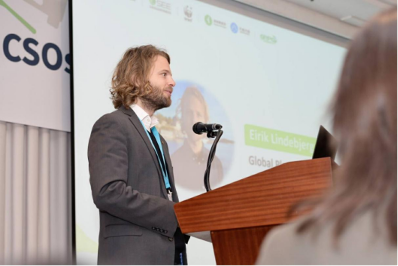 Eirik Lindebjerg (Global Plastics Policy Manager, WWF)  Yao Ni (Deputy Director of Department of International Cooperation, ACEF) Yonggang Wang (China National Resources Recycling Association), Yimo Zhang (WWF), Pinky Chandran (Break Free from Plastic), Mari Kristin Martinsen (Norwegian Retailers’ Environment Fund), Maria Ivanova (UN Science-Policy-Business Forum on the Environment), Da Mao (Shenzhen Zero Waste), Ping Deng (Pacific Environment and Resource Center), Bin Li (GRPG), Zhiyao Lu (SEE Foundation), Chengcheng Jin (WWF). During the two panels roundtable discussion, different parties shared their experiences and challenges from the perspectives of Producer Responsibility in the Plastic Supply Chain, and Social Mobilization and Policy Advocacy for Plastic Management. Mobilization and Policy Advocacy for Plastic Management.  Panel 1: Moderator Gao Yang, panelists Yichun Ma, Dr. Runchao Mao, Bin Li, and Xuesong Liu 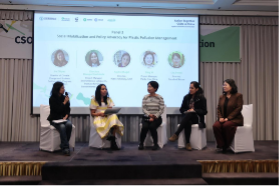 Panel 2: Moderator Zhiyao Lu, panelists Chochoe Devaporihartakula, Yi Ding, Arpita Bhagat, Jinmei Liu In this "global battle against plastic," China's role is particularly crucial. As an important participant in the global environmental governance, China has made strong commitments to address plastic pollution and has strengthened the governance of the full life cycle of plastic pollution through a series of policies and technological innovations. Chinese civil society is also actively taking action, sharing its successful experiences with the international community, and working alongside countries around the world to combat plastic pollution. Moving forward, ACEF, together with Chinese civil society organizations and all stakeholders, will continue to tell the story of China, contribute Chinese wisdom, and offer China’s practical experience in the global effort to address plastic pollution. A joint plastic pollution governance initiative was launched in INC-5, calling for global support in developing an international legally binding instrument on plastic pollution. Joint Statement of Chinese CSOs on Plastic Pollution Control for INC-5 In response to Resolution 5/14 adopted by the United Nations Environment Assembly on the development of an international legally binding instrument on plastic pollution, including in the marine environment (hereinafter referred to as the "Convention"), and to promote the timely achievement of the Convention by the end of 2024, All-China Environment Federation, SEE Foundation, Shenzhen Zero Waste Environmental Public Welfare Development Center, and Green Recycling Plastic Supply Chain Group (GRPG) jointly issue the following statement to Governments and stakeholders worldwide ahead of the fifth session of the Intergovernmental Negotiating Committee (INC-5) in Busan, South Korea: 1. Promote Ambitious and Pragmatic Agreement Governments are encouraged to formulate the international convention with balanced “ambitious and pragmatic” in order to establish the comprehensive strategy and action plan for governing plastic pollution, covering the full life cycle of plastics. 2. Strengthen Research and Data Monitoring Enhance fundamental research on plastics, particularly improving systems for monitoring and tracking of plastic-related data, including plastics that leak into the environment. And identify the optimal production and consumption scale and pathways for integrating sustainable plastics into the economy. Such research will provide critical support for the development of key policies. 3. Encourage Multi-Stakeholder Collaboration Facilitate the creation of collaboration platforms that engage multiple stakeholders, including civil society organizations, to address plastic pollution governance. Local governments and internet platform enterprises are urged to play leading and exemplary roles in pioneering innovative solutions. 4. Establish Mechanisms to Restrict and Phase Out Problematic Plastics Establish the identification mechanism for plastic products that need to be restricted and phased out, and effectively managing the environmental pollution and human health impacts caused by problematic and unnecessary plastic products. 5. Promote Reuse-Oriented Business Models Support and promote the business model of plastic reuse, fully utilizing the power of market. Leverage green financial instruments and develop relevant industry standards and technical specifications to promote the establishment and development of the plastic circular economy. 6. Strengthen Waste Management Systems Governments should establish cross-departmental cooperation mechanisms and abide to waste management hierarchy to create effective local plastic recycling systems, strengthening the classification, collection, transportation, storage and recycling. 7. Raise Public Awareness and Promote Green Consumption Promote public awareness campaigns to encourage consumers to reduce and refuse the use of disposable plastic products. Foster behaviors centered on waste sorting, reuse, and green consumption, encouraging a culture of resource conservation and maximal resource utilization in daily life. Initiating Organizations: All-China Environment Federation, SEE Foundation, Shenzhen Zero Waste Environmental Public Welfare Development Center, Green Recycling Plastic Supply Chain Group (GRPG) Support the Joint Statement: https://lxi.me/3cEvJz |
(This English version is for your reference only.In case any discrepancy exists between the Chinese and English context, the Chinese version shall prevail.)